
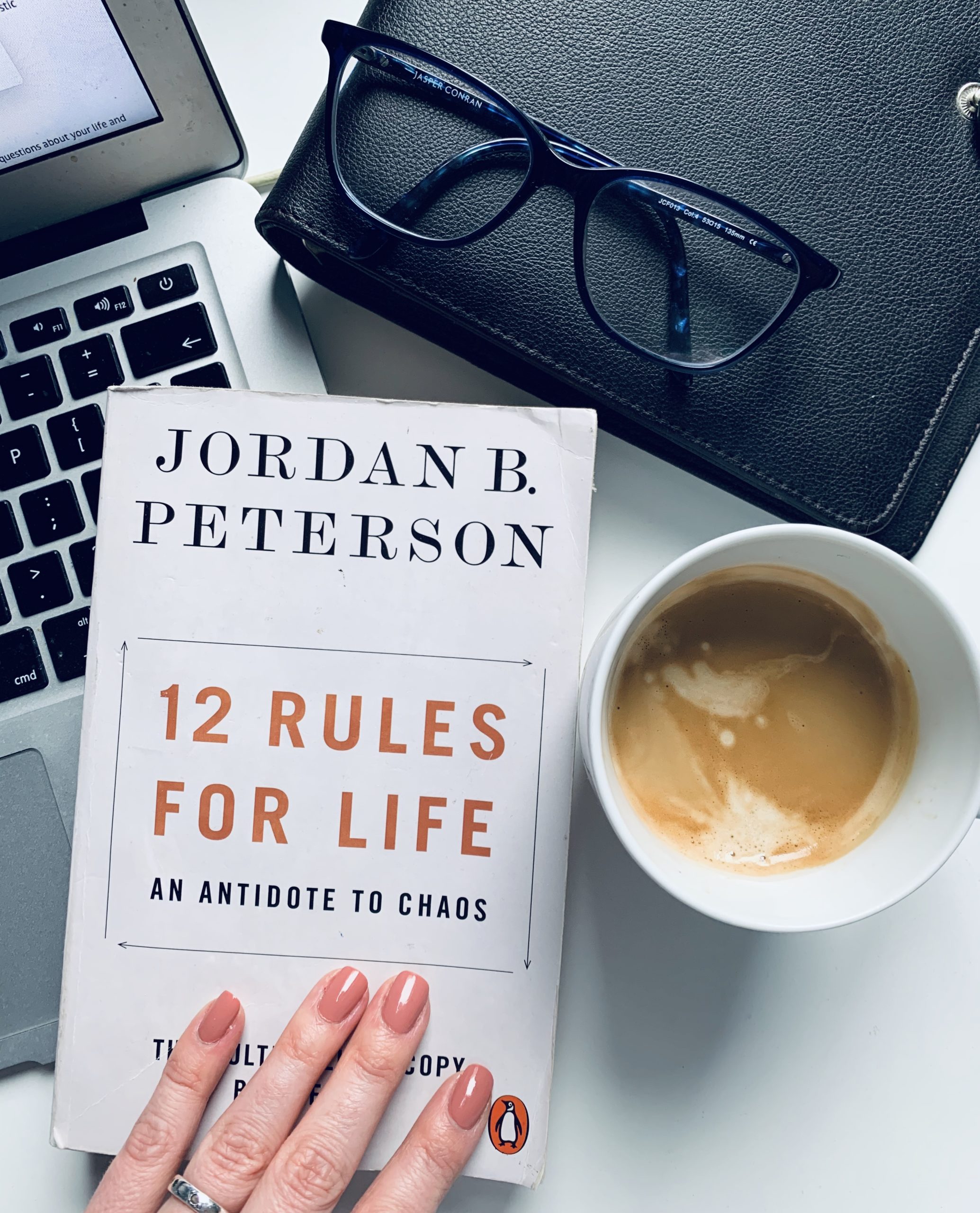

Lately, I started considering some controversial and purely abstract concepts such as good and evil, chaos and order, power and weakness, freedom and constraint, happiness and suffering, law and anarchy, love and hate, faith and faithlessness, to mention a few. These abstract terms are powerful, interconnected and they shape our world. But what really bothers me is our tendency or vulnerability as humans to have experiences relating to any of them.
Furthermore, these abstract ideas and a few others are responsible for what an author, Jordan Peterson, called the tragedy of existence. So, how are we supposed to conduct ourselves in order not to get messed up by those crucial, conflicting abstract ideas? Jordan Peterson in one of his books suggested 12 rules for a good life. So, I will be summarizing the 12 Rules for Life: An Antidote to Chaos by Jordan B Peterson. Kindly note that excerpts from the book are in quotations.
Peterson’s 12 rules
Rule 1: Stand up straight with your shoulders back
In other words, arise and shine — put up a posture to fight challenges and limitations. If you are depressed, you need to stand up and if you have been disappointed and denied in the past, it is time to arise and shine. Standing up makes you vulnerable but it also gives you the opportunity to confront the world in a courageous manner.
“To stand up straight with your shoulders back is to accept the terrible responsibility of life, with eyes wide open. It means deciding to voluntarily transform the chaos of potential into the realities of habitable order. It means adopting the burden of self-conscious vulnerability, and accepting the end of the unconscious paradise of childhood, where finitude and mortality are only dimly comprehended. It means willingly undertaking the sacrifices necessary to generate a productive and meaningful reality (it means acting to please God, in the ancient language).”
Rule 2: Treat yourself like someone you are responsible for helping
You don’t have to be nice to yourself to discover you. Being overly nice to you is a pointer you’re mean to yourself. What you need is to treat yourself with respect and be conscious of your frailty. The golden rule (Mathew 12:31) is to love others as yourself. Don’t be obsessed in helping others that you forget yourself. You deserve to be cared for!
“People are better at filling and properly administering prescription medication to their pets than to themselves.
If we wish to take care of ourselves properly, we would have to respect ourselves — but we don’t, because we are — not least in our own eyes — fallen creatures. If we lived in Truth; if we spoke the Truth — then we could walk with God once again, and respect ourselves, and others, and the world. Then we might treat ourselves like people we cared for. We might strive to set the world straight. We might orient it toward Heaven, where we would want people we cared for to dwell, instead of Hell, where our resentment and hatred would eternally sentence everyone.”
Rule 3: Make friends with people who want the best for you
Try to be make friends with those people that are willing and ready to support you till you realize your potentials and win. You have the ethical responsibility to surround yourself with people who have the wisdom, courage and faith to cheer you up when you are doing something good and to stop or reprimand you when you are doing something bad or destructive. Basically, get attracted to good healthy people and distant from bad unhealthy ones.
“Here’s something to consider: If you have a friend whose friendship you wouldn’t recommend to your sister, or your father, or your son, why would you have such a friend for yourself? You should choose people who want things to be better, not worse. It’s a good thing, not a selfish thing, to choose people who are good for you. It’s appropriate and praiseworthy to associate with people whose lives would be improved if they saw your life improve.”
Rule 4: Compare yourself with who you were yesterday, not with who someone else is today
You need to benchmark your life with your past and future possibilities- rather than envying others. In the age of social media, you can get trapped into thinking some people have it better. That is not true! Face your own realities. What do you want and where are you at the moment? An honest self evaluation would help you determine things you truly desire and how to get them. We are designed to envision a better future and growth is an evidence you are not having a better past.
“No matter how good you are at something, or how you rank your accomplishments, there is someone out there who makes you look incompetent.
Even when satisfied, temporarily, we remain curious. We live within a framework that defines the present as eternally lacking and the future as eternally better. If we did not see things this way, we would not act at all. We wouldn’t even be able to see, because to see we must focus, and to focus we must pick one thing above all else on which to focus. The future is like the past. But there’s a crucial difference. The past is fixed, but the future — it could be better. It could be better, some precise amount — the amount that can be achieved, perhaps, in a day, with some minimal engagement.”
Rule 5: Do not let your children do anything that makes you dislike them
This rule is for parents and intending ones. You have a role to discipline or punish your child when they begin to come up with unwanted behaviors. If they do what is desirable, reward them and if they do otherwise, effectively discipline them. You have to teach your children about societal, ethical behavior at a very early age so that you don’t end up being resentful or disliking them when they begin to unconsciously develop bad habits. Jordan also stressed the fact that parenting should come in pairs so as to jointly produce children that are ‘socially desirable’.
“Two-year-olds, statistically speaking, are the most violent of people. They kick, hit and bite, and they steal the property of others. They do so to explore, to express outrage and frustration, and to gratify their impulsive desires. More importantly, for our purposes, they do so to discover the true limits of permissible behavior. How else are they ever going to puzzle out what is acceptable? Infants are like blind people, searching for a wall. They have to push forward, and test, to see where the actual boundaries lie (and those are too-seldom where they are said to be).”
Rule 6: Set your house in perfect order before you criticize the world
Life is tragic but you don’t have to go all day complaining. Before you begin to blame capitalism, the radical left and other forms of ills you perceive in the world, are you playing your part to make the world around you better?
“Have you cleaned up your life? If the answer is no, here’s something to try: Start to stop doing what you know to be wrong. Start stopping today. Don’t waste time questioning how you know that what you’re doing is wrong, if you are certain that it is.
Don’t reorganize the state until you have ordered your own experience. Have some humility. If you cannot bring peace to your household, how dare you try to rule a city?”
Rule 7: Pursue what is meaningful (not what is expedient)
You have got to do the things that are purposeful: avoid quick and easy stuffs that appears to be important for a short moment. In other words, focus on a higher purpose, sacrifice and douse the desire for pleasure and instant gratification. Sacrifice isn’t sexy at all -it’s a savage idea- but it holds the key to an improved future. Don’t deprive your soul of meaning!
“Consider the murderousness of your own spirit before you dare accuse others, and before you attempt to repair the fabric of the world. Maybe it’s not the world that’s at fault. Maybe it’s you. You’ve failed to make the mark. You’ve missed the target. You’ve fallen short of the glory of God. You’ve sinned. And all of that is your contribution to the insufficiency and evil of the world.
To have meaning in your life is better than to have what you want, because you may neither know what you want, nor what you truly need. Meaning is something that comes upon you, of its own accord. You can set up the preconditions, you can follow meaning, when it manifests itself, but you cannot simply produce it, as an act of will. What is expedient works only for the moment. It’s immediate, impulsive and limited. What is meaningful, by contrast, is the organization of what would otherwise merely be expedient into a symphony of Being.”
Rule 8: Tell the truth — or, at least, don’t lie
You are wise and conscientious when you choose to speak nothing but the truth always. Lying corrupts the soul. Take a path of finding your personal truth and live it unapologetically.
“I soon came to realize that almost everything I said was untrue. I had motives for saying these things: I wanted to win arguments and gain status and impress people and get what I wanted. I was using language to bend and twist the world into delivering what I thought was necessary. But I was a fake. Realizing this, I started to practice only saying things that the internal voice would not object to. I started to practice telling the truth — or, at least, not lying. I soon learned that such a skill came in very handy when I didn’t know what to do. What should you do, when you don’t know what to do? Tell the truth.”
Rule 9: Assume that the person you are listening to might know something you don’t
This chapter is about humility and listening. One of the greatest good you can do for yourself is to listen to you (through a thinking process) and to those that have the potential to let you know something. Learn to become a good listener!
“Carl Rogers, one of the twentieth century’s great psychotherapists, knew something about listening. He wrote, “The great majority of us cannot listen; we find ourselves compelled to evaluate, because listening is too dangerous. The first requirement is courage, and we do not always have.
If you listen, instead, without premature judgment, people will generally tell you everything they are thinking — and with very little deceit. People will tell you the most amazing, absurd, interesting things. Very few of your conversations will be boring. (You can in fact tell whether or not you are actually listening in this manner. If the conversation is boring, you probably aren’t.)”
Rule 10: Be precise in your speech
In this rule, Jordan emphasizes the importance of having precise communication with the people around us. This gives the ability to manage differences while also protecting our self interest. He illustrated this with the story of a married couple that both neglected speaking up precisely of what they wanted in their relationship until chaos sets in.
“When things break down, what has been ignored rushes in. When things are no longer specified, with precision, the walls crumble, and chaos makes its presence known. When we’ve been careless, and let things slide, what we have refused to attend to gathers itself up, adopts a serpentine form, and strikes — often at the worst possible moment. It is then that we see what focused intent, precision of aim and careful attention protects us from.
Chaos emerges in a household, bit by bit. Mutual unhappiness and resentment pile up. Everything untidy is swept under the rug, where the dragon feasts on the crumbs. But no one says anything, as the shared society and negotiated order of the household reveals itself as inadequate, or disintegrates, in the face of the unexpected and threatening. Everybody whistles in the dark, instead.
Confront the chaos of Being. Take aim against a sea of troubles. Specify your destination, and chart your course. Admit to what you want. Tell those around you who you are. Narrow, and gaze attentively, and move forward, forthrightly. Be precise in your speech.”
Rule 11: Do not bother children when they are skate-boarding
Staking is cool and very dangerous. But children don’t only skate because it is fun, they do so to master how to be safe and confront the unenviable or impending chaos in the world. Further building on this rule, Jordan addresses issue regarding gender and patriarchy. In his opinion, hierarchy in form of race or gender does not create winners or losers. What does is personal merit. He also believes patriarchy is a good thing and it’s not responsible for the suffering in our world today.
“Want to know why the world is falling apart? It’s because liberals are turning boys into girlies with their namby-pamby ways. Let boys do boy things and girls do girl things. Nowhere in the Bible does God say anything about this trans nonsense. There’s nothing wrong with men having all the best jobs and women staying home to look after the kids. So back off, ladies, and give us men a break.“
Rule 12: Pet a cat when you encounter one on the street
Crisis and suffering are inevitable parts of life but some have a very big part to bite. What do you do when overwhelmed by crisis? Maybe you need you need to start embracing the good part of life, more and more. The fact is that we are all going to die; hence, make peace with the chaos life has to present while you exist. Gladly pet a cat or dog on the street and smell beautiful roses when you see one.
“If you pay careful attention, even on a bad day, you may be fortunate enough to be confronted with small opportunities of just that sort. Maybe you will see a little girl dancing on the street because she is all dressed up in a ballet costume. Maybe you will have a particularly good cup of coffee in a café that cares about their customers. Maybe you can steal ten or twenty minutes to do some ridiculous thing that distracts you or reminds you that you can laugh at the absurdity of existence.”
Conclusion
I have tried to summarize Jordan Peterson 12 rules for life. The rules described are not the ultimate! But the big lesson is this: rules bring order to our life and without them, there will be uncertainty and chaos. You can start embracing the rules that will help you live a good life today.
I hope you have found some valuable lessons in this read. Follow me for more stories, book review and interesting content on personal development.
I am Samuel Ayankoso (the Quester)






Been rolling with this platform for a while now and it never disappoints. The promotions actually feel genuine and the game variety keeps things interesting. It is like having a seasoned veteran guide you through every round with patience and care. Ready to level up your gaming. Search for vnnm88 today.
Been rolling with this platform for a while now and it never disappoints. The promotions actually feel genuine and the game variety keeps things interesting. It is like having a seasoned veteran guide you through every round with patience and care. Ready to level up your gaming. Search for vnnm88 today.
I have been playing here for months and the vibe is always amazing. The platform stays clean and deposits go through instantly. Definitely my go to spot for weekend fun and it never disappoints. baji112233
I spend most of my free time here and it never gets old. The game library is constantly updated and I love discovering new favorites every week. Betting odds are incredibly fair and the payout ratios are among the best I have seen. It is hands down the most trustworthy site I have used this year. Join the fun at phwk776
Best place to unwind and try your luck. The game variety is amazing and everything feels very secure. Five stars from me! casinoevo
Finally found a login link that actually works without any redirects. Great service and the support team is very responsive. Give nibung88login a try.
[9650]অনলাইন ক্যাসিনো ও ক্রিকেট বেটিং (baji) – বাংলাদেশের সেরা সাইট,baji বাংলাদেশের শীর্ষস্থানীয় অনলাইন ক্যাসিনো ও ক্রিকেট বেটিং প্ল্যাটফর্ম। নিরাপদ লেনদেন, লাইভ গেম এবং আকর্ষণীয় বোনাস উপভোগ করুন। আজই যোগ দিন এবং সেরা গেমিং অভিজ্ঞতা পান! visit: baji
Finally found an APK that actually works without any lag. The interface is very user friendly and the payouts are legit. Love using peryaplusapk on my phone
[148]1win লগইন ও অ্যাপ ডাউনলোড | বিকাশ দিয়ে ক্যাসিনো ডিপোজিট,1win login করার নিয়ম জানুন এবং অ্যান্ড্রয়েড ক্যাসিনো অ্যাপ ডাউনলোড করে অনলাইন স্লট গেম খেলার নিয়ম শিখুন। আজই জয়েন করুন। visit: 1win